
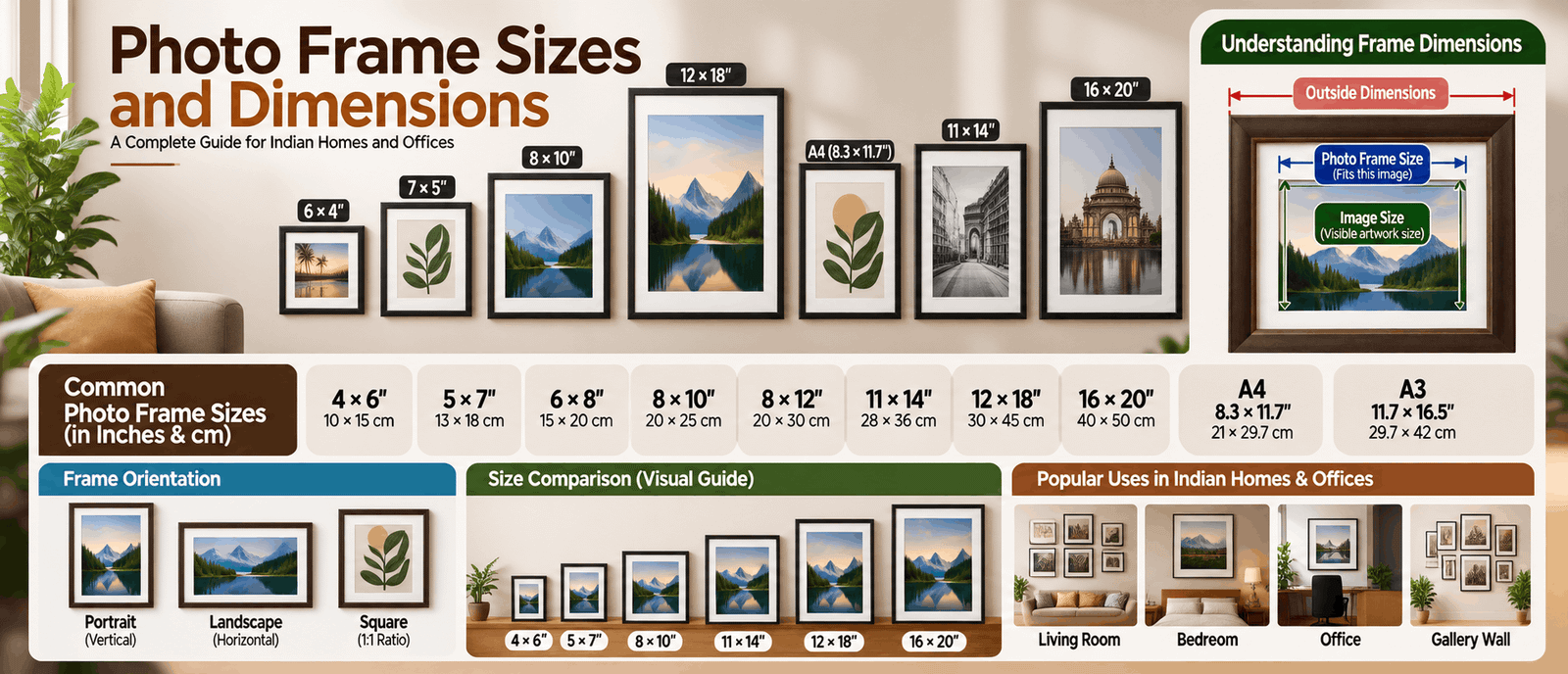
Choosing the right photo frame size is important when displaying photographs, family portraits, certificates, posters, or printed artwork. A frame that is too small may crop important parts of an image, while an oversized frame may not fit the wall or the space where you want to display it.
In India, photo frames are commonly sold in inches, while some frames and artwork are measured in centimetres. You may also come across standard paper sizes such as A4 and A3. Understanding these measurements helps you choose a frame that fits your image and suits your room.
This guide explains common photo frame sizes in India, how to measure a frame, the difference between image size and outside dimensions, portrait and landscape orientation, aspect ratio, and how a mount board affects the visible image. Explore our complete photo frame guide article for a clear idea of frames and uses.
What Are the Standard Photo Frame Sizes in India?
There is no single standard size for every photo frame in India. Available sizes vary by manufacturer, frame design, intended use, and the type of image being displayed.
However, several sizes are commonly used for personal photographs, home decoration, printed artwork, and wall displays.
Common photo frame sizes in inches and centimetres
The following table provides a practical reference for common rectangular frame sizes. Centimetre measurements are rounded to two decimal places where necessary.
| Frame size (inches) | Approximate size (cm) | Common use |
|---|---|---|
| 4 × 6 | 10.16 × 15.24 | Small photographs, desk displays |
| 5 × 7 | 12.70 × 17.78 | Portraits, family photographs |
| 6 × 8 | 15.24 × 20.32 | Personal photographs, tabletop displays |
| 8 × 10 | 20.32 × 25.40 | Portraits, small wall artwork |
| 8 × 12 | 20.32 × 30.48 | Vertical or horizontal photographs, printed artwork |
| 10 × 12 | 25.40 × 30.48 | Portraits and decorative prints |
| 12 × 15 | 30.48 × 38.10 | Medium-sized artwork |
| 12 × 18 | 30.48 × 45.72 | Wall art, decorative prints, family portraits |
| 16 × 20 | 40.64 × 50.80 | Larger portraits and wall displays |
| 18 × 24 | 45.72 × 60.96 | Posters and decorative artwork |
| 20 × 30 | 50.80 × 76.20 | Large wall art and posters |
These measurements generally refer to the intended image size, not necessarily the frame’s total outside dimensions. Always check the seller’s product specifications. You can visit the Photo Frame Sizes in Inches article for more detailed information.
Which photo frame sizes are suitable for Indian homes?
The right size depends on where you plan to display the frame.
- 4 × 6 inches: Suitable for small family photographs, bedside tables, and office desks.
- 5 × 7 inches: Useful for individual portraits, couple photographs, and small decorative displays.
- 8 × 10 inches: Suitable for personal photographs and smaller wall arrangements.
- 8 × 12 inches: A useful option for vertical portraits and certain ready-made printed artworks.
- 12 × 18 inches: Suitable for decorative wall art, spiritual prints, and larger photographs.
- 16 × 20 inches and above: Useful when you want an image to become a more prominent feature on a wall.
These are general use cases, not strict rules. You can use almost any suitable size depending on your available space and the image’s proportions.

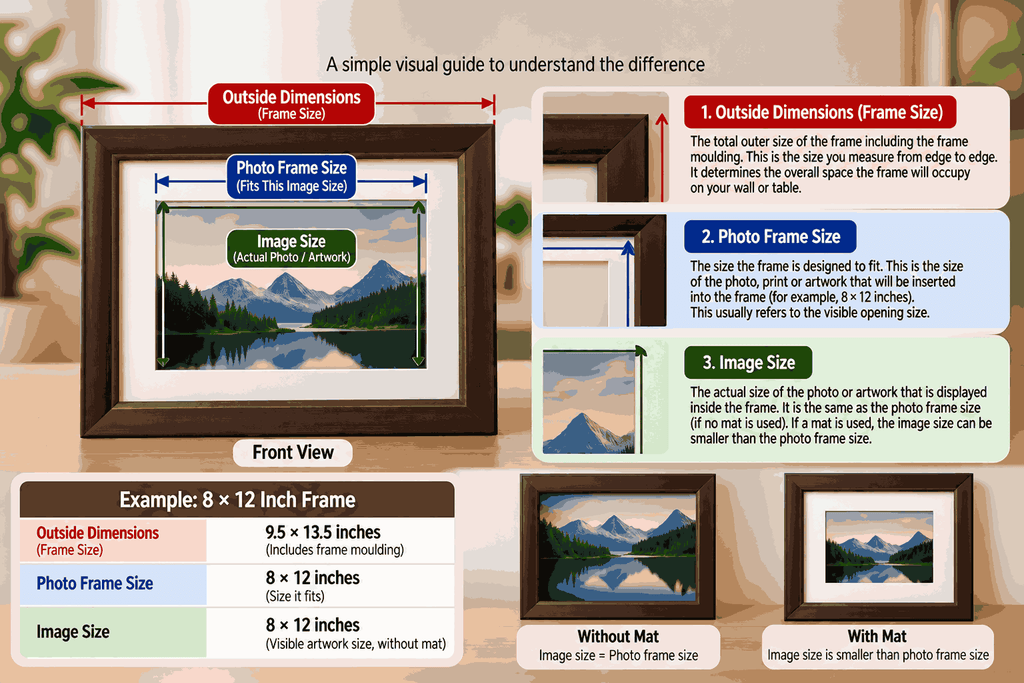
Photo Frame Size vs Image Size vs Outside Dimensions
One of the most common sources of confusion when buying a photo frame online is the difference between image size, visible opening, and outside frame dimensions.
These three measurements describe different parts of the frame.
What is image size?
Image size refers to the dimensions of the photograph, poster, or artwork the frame is designed to hold.
For example, an 8 × 12-inch frame is generally intended for an image measuring 8 inches wide and 12 inches high in portrait orientation.
If your printed photograph is 8 × 12 inches, you would normally look for a frame made for that image size.
What is the visible opening of a picture frame?
The visible opening is the area through which you can see the photograph or artwork after it has been placed inside the frame.
This opening may be slightly smaller than the image size because the frame border overlaps the edges to keep the image securely held.
A mount board can also reduce the visible area of the image.
For example, a frame designed for an 8 × 12-inch image may display slightly less than the full image area. The exact opening depends on the frame’s construction.
What are outside frame dimensions?
Outside dimensions refer to the total width and height of the assembled frame, measured from its outermost edges.
They include the frame border.
For example, a frame designed to hold an 8 × 12-inch image may have outside dimensions of approximately 9 × 13 inches if the border adds about half an inch on each side. This is only an illustration; actual dimensions vary by product.
Outside dimensions are particularly important when checking whether a frame will fit above a sofa, between shelves, or within a designated wall space.
Quick comparison
| Measurement | What it tells you |
|---|---|
| Image size | The size of the photograph or artwork the frame is designed to hold |
| Visible opening | The part of the image you can see after framing |
| Outside dimensions | The total width and height of the assembled frame |
| Mount opening | The opening cut into a mount board around the image |
Practical tip: When buying a ready-made photo frame online, check whether the listed size refers to the image it holds or the frame’s outside dimensions.
A4, A3 and Other Paper Sizes for Photo Frames in India
Paper sizes are another important consideration when choosing a picture frame in India. A-series paper sizes are widely used for documents, certificates, printed artwork, and posters.
The A-series follows the ISO 216 paper-size system. Each successive size, such as A3 to A4, has half the area of the preceding size.
Common A-series sizes
| Paper size | Dimensions in mm | Approximate dimensions in inches |
|---|---|---|
| A5 | 148 × 210 mm | 5.83 × 8.27 inches |
| A4 | 210 × 297 mm | 8.27 × 11.69 inches |
| A3 | 297 × 420 mm | 11.69 × 16.54 inches |
| A2 | 420 × 594 mm | 16.54 × 23.39 inches |
| A1 | 594 × 841 mm | 23.39 × 33.11 inches |
What is an A4 photo frame size?
An A4 sheet measures 210 × 297 mm, or approximately 8.27 × 11.69 inches.
A4 frames are useful for displaying certificates, documents, illustrations, and printed artwork produced on A4 paper.
However, an A4 frame is not exactly the same size as an 8 × 12-inch frame.
An 8 × 12-inch image measures approximately 203.2 × 304.8 mm. Compared with A4, it is slightly narrower and taller.
Therefore, if your artwork is printed on A4 paper, look for an A4-compatible frame rather than assuming that an 8 × 12-inch frame will fit it perfectly.
What is an A3 photo frame size?
An A3 sheet measures 297 × 420 mm, approximately 11.69 × 16.54 inches.
An A3 frame can be suitable for larger certificates, illustrations, posters, and artwork printed on A3 paper.
As with A4, check the actual image dimensions and the frame’s intended insert size before purchasing.
Are A-series sizes the same as inch-based frame sizes?
No. A-series sizes are defined in millimetres, while sizes such as 8 × 10, 8 × 12, and 12 × 18 inches use inch-based dimensions.
Some sizes may be close to one another, but they are not necessarily interchangeable. Even a small difference can cause an image to fit loosely, overlap the frame border, or require trimming.
How to Measure a Photo Frame Correctly
Measuring a photo frame correctly helps you choose a replacement frame, plan a wall display, or determine whether a particular photograph will fit.
Before measuring, decide whether you need the image size, the visible opening, or the frame’s outside dimensions.
How to measure the image
If you already have a printed photograph or artwork, measure its width and height using a ruler or measuring tape.
- Place the image on a flat surface.
- Measure from the left edge to the right edge.
- Measure from the top edge to the bottom edge.
- Record the width first and the height second.
- Compare the measurements with the frame’s listed image size.
For example, if your photograph measures 20.3 cm × 30.5 cm, it is approximately an 8 × 12-inch image.
How to measure the outside of a frame
If you want to check whether a frame will fit a particular wall space, measure the assembled frame from its outermost left edge to its right edge, then from its top edge to its bottom edge.
Do not measure only the visible photograph or the inside opening when planning the space required on your wall.
How to measure an existing frame’s image opening
If you already own a frame, measure the inside opening where the image sits. Be aware that the visible opening may be smaller than the image size because the border overlaps the edges.
If the frame has a mount board, measure the opening cut into the mount as well.
For a replacement frame, measuring the original photograph or artwork is often more reliable than measuring the visible opening alone.
Portrait vs Landscape Photo Frames: What’s the Difference?
Portrait and landscape refer to the orientation of an image, not a different standard of measurement.
Portrait orientation
A portrait frame is taller than it is wide.
For example, an 8 × 12-inch frame used vertically has a width of 8 inches and a height of 12 inches.
Portrait orientation is commonly used for individual portraits, full-length photographs, vertical artwork, and many spiritual or devotional prints.
Landscape orientation
A landscape frame is wider than it is tall.
The same 8 × 12-inch frame can be used horizontally by placing the 12-inch side across the width and the 8-inch side vertically.
Landscape orientation is commonly used for group photographs, scenic pictures, panoramic-style compositions, and horizontal artwork.

Can the same photo frame be used in both orientations?
Many rectangular frames can be rotated between portrait and landscape orientations, provided their rear fittings support the intended display method.
However, a printed image must also match the orientation of the frame opening. Rotating a frame does not change the image’s proportions.
If you are purchasing a ready-made frame with printed artwork, check whether the design is intended for portrait or landscape display.
What Is Aspect Ratio and Why Does It Matter for Framed Pictures?
Aspect ratio describes the proportional relationship between an image’s width and height.
For example, an image measuring 8 × 12 inches has an aspect ratio of 2:3 when written in width-to-height order.
The aspect ratio matters because a photograph may not fit a frame with different proportions without cropping, adding empty space, or changing the presentation.
Common photo and frame aspect ratios
| Image dimensions | Aspect ratio (width) |
|---|---|
| 4 × 6 inches | 2:3 |
| 5 × 7 inches | 5:7 |
| 8 × 10 inches | 4:5 |
| 8 × 12 inches | 2:3 |
| 12 × 18 inches | 2:3 |
| 16 × 20 inches | 4:5 |
What happens when the aspect ratios do not match?
Suppose you have a photograph measuring 8 × 12 inches but want to place it in an 8 × 10-inch frame.
The two sizes have different proportions. The entire photograph cannot fill the opening in both directions without either leaving space or cropping part of the image.
You can address this by choosing a frame with matching proportions, using a mount board where appropriate, or cropping the image before printing if you are comfortable losing some of the original content.
For family portraits, wedding photographs, and artwork with important details near the edges, avoid cropping without checking the composition first.
How Does a Mount Board Affect the Visible Size of a Photo?
A mount board, also called a mat board, is an optional border placed between the image and the outer frame.
It creates visual space around the image and can help the artwork stand out. However, the opening cut into the mount determines how much of the image remains visible.
For example, a mount board inside a frame designed for an 8 × 12-inch image could have a smaller opening that intentionally covers a narrow portion of the image’s edges.
The actual opening depends on the mount design.
Does a mount board change the frame’s outside size?
No. Adding a mount board inside a frame does not automatically change the assembled frame’s outside dimensions.
It can change the visible image area and how the image is positioned inside the frame.
Should you choose a frame with or without a mount?
A frame without a mount may suit simple photographs, compact displays, or artwork intended to fill most of the frame opening.
A frame with a mount can be useful when you want additional visual separation between the image and the frame border.
If the artwork has text, a signature, or important details close to the edges, check the mount opening carefully before choosing the frame.
How to Choose the Right Photo Frame Size for Different Rooms
The right frame size depends on the available space, the image’s proportions, and the visual effect you want to create.
Living room
For a living room, consider how the frame will relate to the sofa, console table, or other furniture. A larger framed artwork can create a focal point, while several smaller frames can form a gallery wall.
Measure the available wall space and include the frame’s outside dimensions when planning the arrangement.
Bedroom
Smaller frames can work well on bedside tables or shelves, while medium-sized frames may suit walls above furniture.
For a group of frames, consider the combined width and height of the arrangement rather than measuring each frame separately.
Office or study
Smaller frames are useful for desk displays, while A4 frames can be practical for certificates or printed documents.
For wall-mounted displays, check the distance between furniture, shelves, and the proposed frame position.
Hallways and narrow walls
Narrow walls may suit portrait-oriented frames or a vertical arrangement of smaller frames. Measure the available width carefully so that the outside edges of the frames do not crowd the space.
Gallery walls
When arranging several photo frames together, plan the overall layout first. Include the gaps between frames when calculating the total space required.
Mixing different frame sizes can create a balanced display, but the relationship between their dimensions should be considered before hanging them.
How Much Space Should You Leave Between Picture Frames?
The spacing between frames affects the overall appearance of a gallery wall.
A consistent gap creates a more orderly arrangement, while varying gaps can produce a more relaxed composition.
For a simple gallery wall, you can start by leaving approximately 5–8 cm between frames and adjust according to the size of the frames and the available wall space. This is a practical starting point rather than a strict rule.
For example, if three frames each have an outside width of 30 cm and you leave 6 cm between them, the total arrangement will be:
30 + 6 + 30 + 6 + 30 = 102 cm.
This calculation helps you determine whether the arrangement will fit the available wall space.
Always use the frames’ outside dimensions rather than their image sizes when planning a wall arrangement.
How to Choose the Right Frame Size for Printed Artwork
Ready-made framed artwork has a slightly different consideration from a photograph you print yourself: the image is already selected or printed as part of the product.
When shopping online, check the product listing for:
- The artwork’s intended size.
- The assembled frame’s outside dimensions.
- Whether the frame includes a mount board.
- Whether the artwork is displayed in portrait or landscape orientation.
- Whether the product arrives ready to hang or requires assembly.
- Whether the listed measurements are in inches or centimetres.
For example, if a framed artwork is advertised as 12 × 18 inches, verify whether that refers to the intended artwork size or the complete frame’s outside dimensions.
This is especially important when comparing products from different sellers, as product listings may use different measurement conventions.
Frequently Asked Questions About Photo Frame Sizes
What is the most common photo frame size in India?
Several sizes are widely available, including 4 × 6, 5 × 7, 8 × 10, 8 × 12, and 12 × 18 inches. The most suitable size depends on the photograph, artwork, and display location.
Is an 8 × 12-inch frame the same as an A4 frame?
No. An 8 × 12-inch frame is intended for an image measuring approximately 203.2 × 304.8 mm, while A4 paper measures 210 × 297 mm. The dimensions are different, so check compatibility before buying.
What is an A4 photo frame size in inches?
A4 paper measures approximately 8.27 × 11.69 inches. An A4-compatible frame is intended to accommodate that paper size, subject to the frame’s design and opening.
How do I know which photo frame size to buy?
Measure the photograph or artwork you want to display, then compare it with the frame’s intended image size. Also check the visible opening and outside dimensions, especially if the frame needs to fit a specific wall space.
Does the frame size include the border?
Not always. A listed frame size may refer to the image it holds rather than the outside of the assembled frame. Check the seller’s measurements to confirm which dimension is being advertised.
Can I put an 8 × 10-inch photo in an 8 × 12-inch frame?
The dimensions do not match exactly. You may be able to use a suitable mount or backing arrangement, but the result depends on the frame’s construction. Check how the image will be secured and whether any empty space will be visible.
What is the difference between frame size and photo size?
Photo size refers to the photograph’s dimensions. Frame size may refer to the intended image size or to the assembled frame’s outside dimensions. Always confirm which measurement is being used.
How much bigger is the outside of a frame than the image?
There is no fixed difference. It depends on the width and shape of the frame border. Measure the specific product’s outside dimensions if you need to know exactly how much wall space it will occupy.
Conclusion
Understanding photo frame sizes and dimensions makes it easier to select the right frame for photographs, certificates, posters, and printed artwork. In India, both inch-based sizes and A-series paper formats are useful, but they should not be treated as interchangeable.
Before buying a frame, check the image size, visible opening, outside dimensions, orientation, and aspect ratio. If the frame includes a mount board, consider how its opening affects the visible image. By comparing these measurements carefully, you can choose a photo frame that fits your artwork and works well in your home or office.
Explore our social media platforms Pinterest, Instagram, and Facebook to watch video content of our Photo Frame product.




Comments (6)