

A photo frame is more than a border around a photograph. It provides a finished appearance, helps display images neatly, and can protect the image from direct handling and some environmental exposure, depending on its construction.
Whether you want to display a family photograph, decorate your living room with framed artwork, create a gallery wall, or place a picture on your desk, understanding photo frames can help you choose the right format, size, material, and style.
Photo frames are available in different designs, including blank frames for your own photographs, tabletop display frames and ready-made frames containing printed artwork. They can differ in their border material, glazing, backing, dimensions, orientation and mounting arrangements.
This guide explains the essential things to know about photo frames and picture frames, from their components and specifications to their everyday uses, maintenance and display.
What Is a Photo Frame or Picture Frame?
A photo frame, also called a picture frame, is a structure designed to hold and display a photograph, printed image, or another suitable flat artwork. It generally consists of a border, a space for the image, and a backing or retaining system. Some frames also include transparent glazing, a mount board, or display hardware.
The terms photo frame and picture frame are often used interchangeably. However, picture frame is a broader term that can describe frames used for photographs, illustrations, art prints, certificates, and other displayable images.
For example, consider three common products:
- Blank photo frame: An empty frame into which you can insert your own photograph or print.
- Photo display frame: A frame designed to display one or more photographs, often on a tabletop or wall.
- Ready-made framed artwork: A frame supplied with an image that has already been printed and fitted. You do not need to order a custom print to complete the product.
- Custom Photo Frame: A frame personalized with your own photograph or chosen image, typically printed and fitted to your preferred size, design, material, or style. The product is customized to your specifications rather than being a standard, ready-made design.
A frame’s purpose is not limited to decoration. Depending on its construction and materials, it may also help keep an image in position, reduce direct contact with the image surface, and provide some protection during everyday display.
However, not every decorative frame provides archival or conservation-level protection. The level of protection depends on the glazing, backing, mounting materials, and surrounding conditions.
What Are the Main Parts of a Photo Frame?
Although frame designs vary according to your design preference, several components are still commonly found in traditional picture frames. Those we will explain here are the main parts of a photo frame.
Frame border or moulding
The border is the visible structure that surrounds the photograph or artwork. It determines much of the frame’s appearance, including its colour, width, profile and finish.
Black-border frames are a versatile option for displaying family photographs, portraits, illustrations and printed artwork. A black border can create visual contrast against a light wall and provide a consistent appearance when several frames are displayed together.
Frame borders can be made from different materials, including plastic, wood, engineered wood, and metal. The material affects the frame’s weight, finish, construction, and maintenance requirements.

Glazing: glass or acrylic
Glazing refers to the transparent protective layer positioned in front of the image, when a frame includes one.
Common glazing materials include glass and acrylic. Both allow the image to remain visible, but their properties differ.
Glass is familiar for its clarity and relatively scratch-resistant surface in many standard applications, although it can break if impacted. Acrylic is generally lighter and may be less prone to shattering, but it can scratch more easily and may require specific cleaning products.
Neither material automatically provides UV protection. That feature depends on the particular glazing product.
Some frames use no glazing at all. The product description should therefore be checked before assuming a frame includes a glass or acrylic front. We have a detailed article on Acrylic vs Glass Photo Frames to help you gain a clear understanding of photo frame glazing.

Image or printed artwork
The image is the photograph, illustration or printed artwork displayed inside the frame.
With a blank frame, you supply the image separately. With ready-made framed artwork, the image is already included as part of the finished product.
The image’s dimensions and orientation should correspond to the frame’s intended display area. An image that is too large may not fit correctly, while an image that is too small may leave unwanted gaps unless a suitable mount or layout is used.
Backing board
The backing board sits behind the photograph or artwork. It helps support the contents and may work with clips, tabs, or other retainers to keep them in position.
Backing materials vary by frame design. Some are rigid, while others are lighter or more flexible. A backing board should not automatically be assumed to provide moisture protection or archival preservation.

Mount board or mat
A mount board, also called a mat board or mat, is a separate border placed between the artwork and the frame’s outer border. It creates visual space around the image and can help separate the artwork from the glazing when properly designed.
Not every photo frame has a mount. Many ready-made frames display an image directly within the border.

Hanging hardware and tabletop support
The display system allows a frame to be positioned on a wall or a flat surface.
Depending on the design, a frame may include wall hooks, D-rings, wire, sawtooth hangers, brackets, or an easel-style back for tabletop display.
These systems are not interchangeable in every situation. The frame’s weight, dimensions, orientation, and the wall or support surface all affect how it should be displayed. Read the detailed article on how to hang a photo frame on a wall, step-by-step guidance.

Types of Photo Frames
Photo frames can be classified by their contents, display method, construction, and intended use. To get full information, read our Types of Photo Frames Explained: A Complete Guide article that helps you to make effective choices in photo frame selection.
Blank photo frames
Blank photo frames are photo frames without a photograph or printed artwork. They allow you to display your own pictures, family portraits, travel photographs, illustrations, or suitable prints.
They are useful when you already have an image you want to display or prefer to choose your own photograph.
Before selecting a blank frame, check the intended image size, visible opening, orientation, and whether glazing and backing are included. Our blank photo frame vs. photo framed with art article gives a clear understanding if you are curious about blank frames and printed frames.

Photo display frames
Photo display frames are designed around the way photographs are presented. Some are intended for desks, shelves and bedside tables, while others are made for wall mounting.
Certain designs accommodate multiple photographs in a single frame. Others are designed for one prominent image.
A tabletop display frame may include an easel back, whereas a wall-mounted frame requires an appropriate hanging arrangement.

Ready-made framed artwork
Ready-made framed artwork combines a printed image with a frame in a finished product. The customer receives the artwork already fitted rather than ordering a print separately and arranging custom framing.
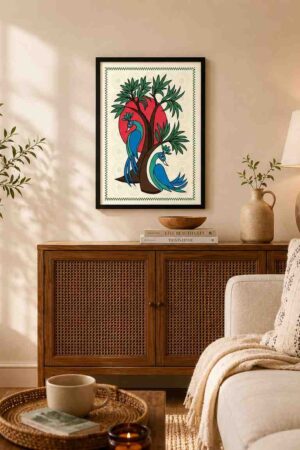
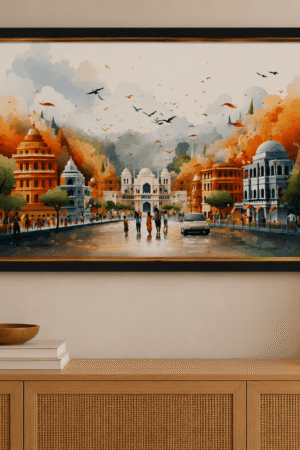
These products may feature religious artwork, traditional Indian imagery, landscapes, abstract designs, portraits or other decorative subjects.
For example, a ready-made Krishna wall art frame or landscape wall art frame can be selected according to the room’s colour palette, available wall space, and the style of artwork you prefer.
The exact image, border, dimensions, and included components depend on the individual product.
Now, most people have a comparison between custom photo frames with ready-made framed artwork, and we explain the details in an article on custom photo frames vs ready-made framed artwork, which is best, so you can explore and get a clear idea.
Collage photo frames
A collage frame contains multiple openings for displaying several photographs together. The arrangement may use images of the same size or combine different image dimensions.
Collage frames can help bring together family photographs, holiday pictures, or memorable events in one display.
When selecting one, check the number of openings, the dimensions of each opening, and the overall frame size.

Shadow box frames
Shadow box frames are deeper than many standard picture frames. Their depth allows them to accommodate certain three-dimensional objects, memorabilia, or layered displays.
They are different from ordinary flat photo frames because their internal space is intended to hold objects that extend beyond a flat image.

Digital photo frames
Digital photo frames use an electronic display to show digital photographs, often with options to rotate images or display a slideshow.
They differ from traditional frames, which present a physical photograph or printed image. Digital frames require power and electronic components, while conventional frames do not.
Custom Photo Frame
A custom photo frame is a personalized frame designed to showcase your favorite photographs, artwork, or memorable moments according to your preferences. You can choose the frame’s size, material, color, design, and finish to complement your photo and interior décor. Custom photo frames are ideal for displaying family portraits, wedding pictures, travel memories, special occasions, or personalized gifts. Unlike ready-made framed artwork, they allow you to select your own image and customize the overall appearance. Whether displayed on a tabletop or mounted on a wall, a custom photo frame adds a personal touch to any space.
Understanding Photo Frame Sizes and Dimensions
Frame measurements can be confusing because the size of the photograph, the visible opening, and the frame’s outside dimensions are not necessarily the same.
Understanding these differences is important when selecting a frame. If you want to get indepth knowledge about the size and dimensions of a photo frame, explore our Photo Frame Sizes and Dimensions complete guide article.
Image size
Image size refers to the width and height of the photograph or print intended to be displayed.
For example, an 8 × 12-inch image measures 8 inches on one side and 12 inches on the other. It can be displayed in portrait or landscape orientation.
Frame size
The stated frame size commonly refers to the image size the frame is designed to accommodate, but product conventions can differ. Always check the manufacturer’s or seller’s measurement description.
A frame described as 8 × 12 inches should not automatically be assumed to have an outside dimension of exactly 8 × 12 inches.
Visible opening
The visible opening is the area through which the image can be seen once it is fitted inside the frame.
The opening may be slightly smaller than the image dimensions so that the image’s edges remain held behind the border. If a mount board is included, its opening also affects how much of the image is visible.
Outside dimensions
Outside dimensions describe the overall width and height of the assembled frame, including its border.
These measurements are especially useful when planning a gallery wall or checking whether a frame will fit within a particular wall space.
Common frame sizes
Common frame sizes include 4 × 6, 5 × 7, 8 × 10, 8 × 12, 11 × 14 and 12 × 18 inches, although availability varies by market and product range.
An A4-sized print measures approximately 21 × 29.7 cm. It is not identical to an 8 × 12-inch print, which measures approximately 20.3 × 30.5 cm.
If you are comparing frame sizes, check the actual measurements rather than relying on similar names alone. Also, we have a detailed article regarding Photo Frame Sizes in Inches that gives you a complete idea.

Portrait and landscape orientation
Portrait orientation means the image is taller than it is wide. Landscape orientation means it is wider than it is tall.
An 8 × 12-inch frame may be positioned vertically or horizontally if its design and hardware support both orientations.
Before hanging a frame, check the artwork’s orientation and the manufacturer’s instructions for changing the display direction.

Photo Frame Materials and Finishes
The border material affects a frame’s appearance, weight, surface finish, and maintenance needs. Get indepth idea of photo frame materials and types to make your choice when buying a photo frame
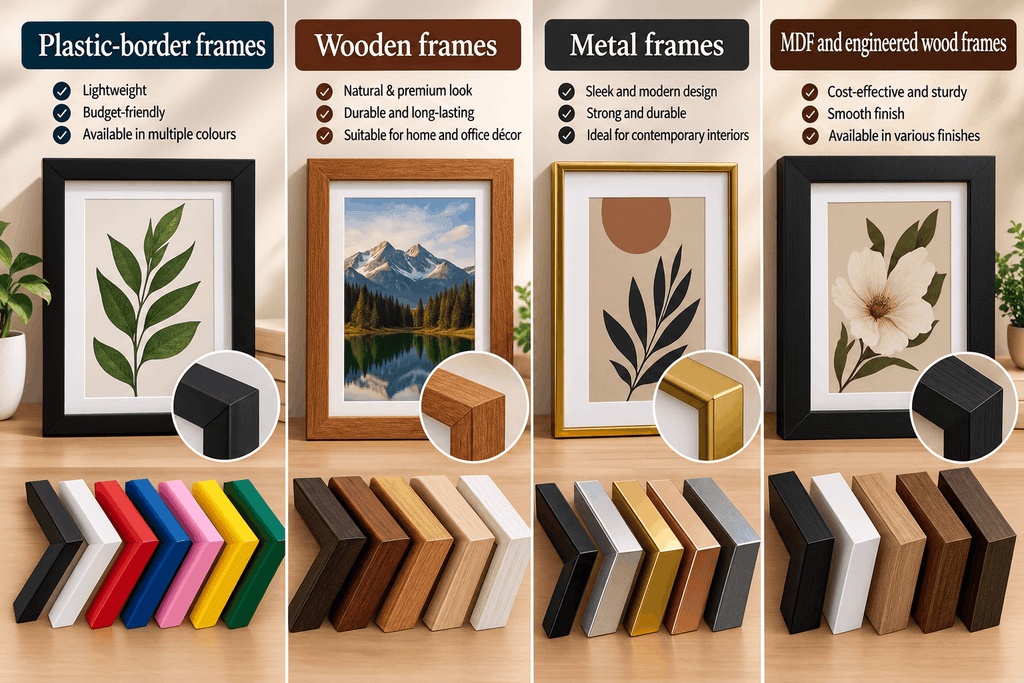
Plastic-border frames
Plastic-border frames are available in a variety of colours, shapes and finishes. They can be a practical option for everyday photo displays and decorative framed artwork.
Black plastic borders are particularly useful when you want a consistent, understated frame colour that works with a range of photographs and printed images.
However, plastic frames are not all identical. Their rigidity, finish, corner construction, scratch resistance and overall durability depend on the particular material and manufacturing quality.
A plastic border also does not necessarily mean that the front glazing or backing is made from plastic. Each component should be considered separately.
Wooden frames
Wooden frames can feature natural grain, stained finishes, painted surfaces and different profile shapes. Their appearance can range from simple and contemporary to traditional and decorative.
Wood is affected by environmental conditions, including changes in humidity. Its behaviour also depends on the type of wood, construction and finish.
Metal frames
Metal frames often have a relatively slim profile and a clean appearance. Their properties depend on the metal, profile design, finish and joining method.
Some metal frames are lightweight, while others may be heavier depending on their construction.
MDF and engineered wood frames
MDF, or medium-density fibreboard, is an engineered wood product made from wood fibres and a binding system. It can be used to create uniform frame profiles and finished surfaces.
MDF should not be treated as identical to solid wood. The materials differ in their structure, moisture response, and available finishes.
Frame finishes
A frame’s finish influences its final appearance. Common finishes include painted, stained, laminated, metallic, and wood-effect surfaces.
Two frames made from different base materials may look similar because of their finishes. For that reason, visual appearance alone does not reliably identify a frame’s underlying material.
How Photo Frames Help Present and Protect Images
A photo frame can serve several functions at the same time. It helps to preserve our memories for the long term.
Visual presentation
The border creates a boundary around the image and helps it stand out from the surrounding wall or display surface.
A black frame, for example, can establish a clear outline around a light-coloured print. The same border can also help different photographs look consistent when arranged together.
Physical support
The frame and backing system help hold the image in position. This can make a framed picture easier to display, move and handle than an unmounted loose print.
Protection from handling and dust
When a frame includes suitable glazing and a reasonably well-fitted backing, it can reduce direct contact with the image and limit some dust exposure.
However, ordinary decorative framing is not necessarily airtight or dustproof. Gaps and the construction of the frame affect its protective performance.
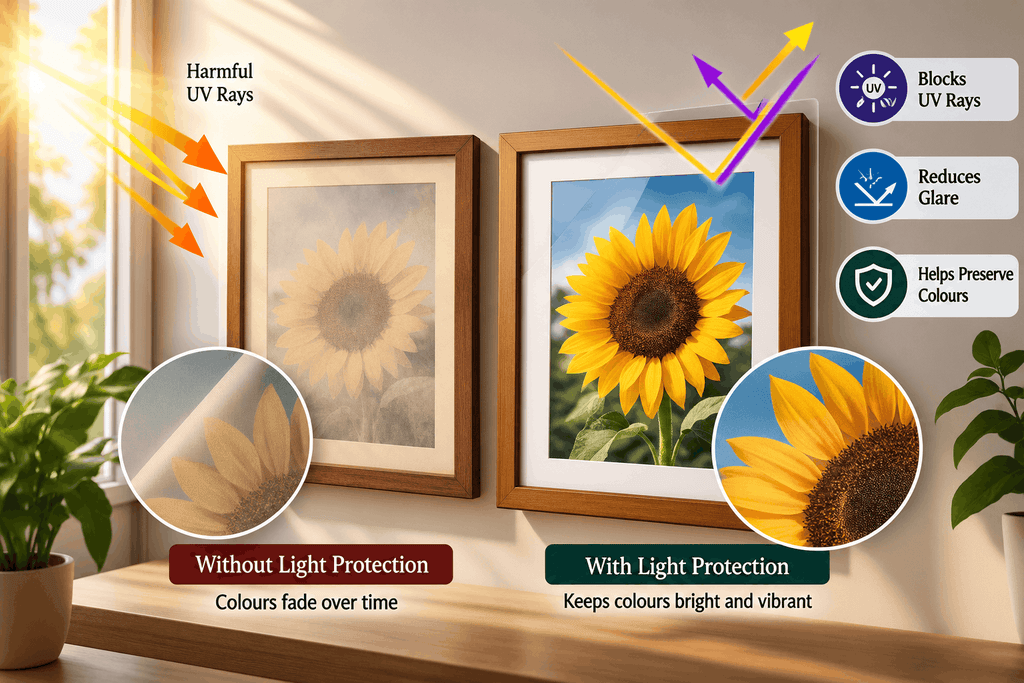
Protection from light
Light can contribute to fading or deterioration in photographs and printed artwork over time. Some glazing products offer UV-filtering properties, but standard glass and ordinary acrylic should not automatically be considered UV-protective.
For valuable or irreplaceable photographs and artwork, conservation framing may be appropriate. The Library of Congress guidance on matting and framing explains how suitable materials and spacing can help protect collection items.
For everyday decorative frames, avoid prolonged direct sunlight and excessively humid locations when possible.
Choosing a Photo Frame for Your Home
The right frame depends on the image, the available space and the way you want to display it.
Match the frame to the image
Consider the artwork’s subject, colours and visual style.
A black-border frame can work with family portraits, monochrome photography, colourful artwork and many traditional or contemporary prints. However, the best choice depends on the complete display rather than the border colour alone.
Consider the wall and surrounding décor
Look at the wall colour, furniture, lighting and nearby decorative elements.
A frame with a strong contrast against the wall can create a prominent display. A frame that blends more closely with the surroundings may produce a quieter appearance.
If you are displaying multiple frames, repeating the same border colour can create visual consistency even when the images differ.
Check the available wall space
Measure the wall area before choosing a frame. Consider both the outside dimensions and the space needed around the frame.
For a gallery wall, plan the arrangement before hanging the pictures. Leave enough room between frames so that each image remains easy to see.
Choose the display method
Wall-mounted frames and tabletop frames serve different purposes.
A wall frame should have suitable mounting hardware and be compatible with the wall and the frame’s weight. A tabletop frame needs a stable support and a suitable surface.
Do not assume every frame can be displayed in both ways. Check its construction and included hardware.
Think about the room’s conditions
Sunlight, humidity, dust, and frequent handling can affect the condition of framed images.
For an image you particularly value, consider the glazing, mounting materials, and environmental conditions rather than assuming that any frame provides complete protection.
How to Display Photo Frames
Displaying photo frames is a simple and creative way to enhance your home decor and showcase your favorite memories. Whether you prefer a single statement frame or a beautiful gallery wall, the right arrangement can add personality and warmth to any space. You can display photo frames in your living room, bedroom, hallway, or office to create an attractive and meaningful environment. Choose frames that complement your interior style, experiment with different sizes and layouts, and ensure proper spacing for a balanced look. With a little creativity, you can transform ordinary walls and surfaces into stunning displays of cherished moments. A frame’s appearance also depends on where and how it is displayed.
Living room
A large framed print can act as a focal point, while several smaller frames can form a gallery wall. When arranging multiple frames, consider their overall balance and their relationship to furniture such as a sofa or console table. Explore our living room photo frame collection.

Bedroom
Framed artwork above a headboard or on a suitable side wall can contribute to the room’s visual style. Consider the available wall space, image colours and the height at which the artwork will be viewed. Explore our Bedroom photo frame collection.

Office or study
A framed photograph, illustration or print can personalise a workspace. A tabletop display frame may be suitable for a desk, while a wall-mounted frame can keep the work surface clear. Explore our workspace photo frame collection.

Shelves and side tables
Tabletop frames can be displayed on shelves, bedside tables and consoles. Check that the support is stable and that the frame is not positioned where it can be easily knocked over.

Gallery walls
A gallery wall combines several framed images in one arrangement. You can use identical frames for a uniform appearance or combine different sizes while maintaining a consistent visual relationship.
Before installing the frames, plan the layout on paper or mark the intended positions on the wall. This can help you assess spacing and alignment before making holes.

How to Clean and Maintain a Photo Frame By Yourself
The correct cleaning method depends on the frame’s materials. For a plastic border, use a soft cloth and follow the product’s cleaning instructions. Avoid abrasive pads and aggressive solvents unless the manufacturer explicitly confirms that they are suitable. For glass glazing, use an appropriate glass-cleaning method while avoiding excess liquid near the frame edges and artwork.
For acrylic glazing, use a cleaning product specifically suitable for acrylic and a soft cloth. Some ordinary glass cleaners and rough materials can damage acrylic surfaces.
For wooden frames, use a dry or appropriately damp soft cloth according to the finish and manufacturer’s instructions. Avoid excessive moisture, especially around joints and unfinished surfaces.
For any frame, remove dust gently and avoid pressing hard against the glazing or artwork.
If a frame contains a valuable photograph or delicate print, take care when opening it. The backing, retaining tabs, and image may be more fragile than they appear. Get full information on photo frame cleaning at home by reading our popular article.
Common Photo Frame Terms Explained
| Term | Meaning |
|---|---|
| Frame border | The visible structure surrounding the image |
| Frame moulding | The material or profile used to form the frame border |
| Glazing | The transparent front layer, when present |
| Backing board | The rear support that helps hold the contents in place |
| Mount board or mat | A border placed around the artwork inside the frame |
| Visible opening | The portion of the image visible through the frame |
| Outside dimensions | The total external width and height of the frame |
| Portrait orientation | An image or frame positioned vertically |
| Landscape orientation | An image or frame positioned horizontally |
| Easel back | A support that allows a frame to stand on a flat surface |
| Collage frame | A frame designed to display multiple images |
| Shadow box | A deeper frame designed to accommodate objects or layered displays |
Understanding these terms makes it easier to compare products, check measurements, and understand frame descriptions.
Frequently Asked Questions About Photo Frames
What is the difference between a photo frame and a picture frame?
The terms are often used interchangeably. Photo frame commonly refers to a frame for photographs, while picture frame can also refer to frames for artwork, illustrations, certificates, and other images.
What are the main parts of a photo frame?
Common parts include the frame border, image, backing, and retaining system. Some frames also include glazing, a mount board, spacers, and display hardware.
What does an 8 × 12-inch photo frame mean?
It commonly indicates the image size the frame is intended to accommodate, but product conventions can vary. Check whether the stated measurement refers to the intended image size or the frame’s outside dimensions.
Can a photo frame be displayed horizontally and vertically?
Some frames support both portrait and landscape orientations. Others have fixed hardware or a design intended for one orientation. Check the product’s construction and instructions.
Do all photo frames include glass?
No. Some frames include glass, some use acrylic, and others have no transparent front layer. The included components depend on the particular product.
Are plastic photo frames suitable for home décor?
Plastic-border frames can be suitable for many everyday decorative displays. Their performance depends on the quality of the material, construction, finish, and included components.
Do picture frames protect photographs from sunlight?
A frame may reduce some forms of physical exposure, but it does not automatically prevent fading caused by light. UV protection depends on the glazing, and prolonged direct sunlight should be avoided for images you want to preserve.
What is the difference between a blank frame and framed artwork?
A blank frame is a frame without an image, allowing you to insert your own photograph or print. Ready-made framed artwork includes an image that has already been printed and fitted into the frame. It’s normally fitted with popular or well-known art or regional wall art that has been printed by the frame seller.
How do I choose the right photo frame size?
Start with the photograph or print’s actual dimensions. Then check the frame’s intended image size, visible opening, and outside dimensions. Consider the available display space and whether a mount is included.
How do I clean a black plastic-border photo frame?
Use a soft cloth and follow the manufacturer’s care instructions. Avoid abrasive materials and unapproved solvents, which may scratch or damage the finish.
How to Arrange Multiple Photo Frames on a Wall?
To arrange multiple photo frames on a wall, first measure your available wall space and choose a layout, such as a horizontal row, symmetrical grid, or asymmetrical gallery wall. Keep consistent spacing between frames, coordinate frame colours and artwork, and plan the arrangement before hanging. For detailed layout ideas for 3, 4, 5, 6, or 9 frames, read our complete guide on How to Arrange Multiple Photo Frames on a Wall: A Complete Gallery Wall Guide.
Conclusion
A photo frame combines a border, an image, and a supporting structure to create a finished display. Its materials, dimensions, glazing, backing, orientation, and mounting arrangements all influence how it looks and functions.
Understanding these features makes it easier to select a blank frame for your own photograph, a display frame for a desk or shelf, or ready-made framed artwork for your home.
The most useful approach is to consider the complete product: the image you want to display, the frame’s actual measurements, the materials and components included, the intended display location, and the level of protection required.
With these details in mind, you can make a more informed choice and create a display that suits your space and the images that matter to you.
Explore our social media platforms Pinterest, Instagram, and Facebook to watch video content of our Photo Frame product.





Comments (11)